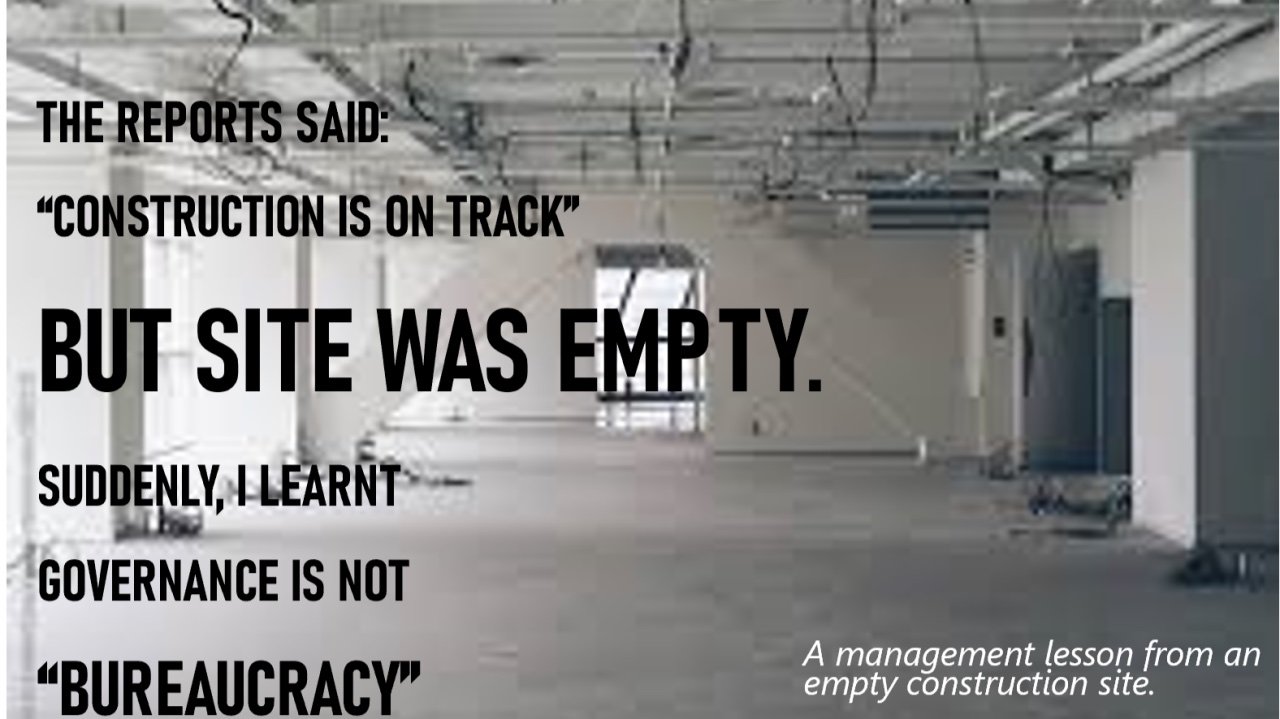
More than twenty years ago, I arrived at a construction site expecting to see a new bank branch taking shape.
There was no contractor. There were no workers. In fact, there was virtually no construction activity taking place at all. The problem was that, according to the reports we had been receiving, the project appeared to be progressing perfectly well.
That experience changed the way I think about governance to this day.
At the time, I was working in banking in Nigeria during an ambitious branch expansion programme. We were managing projects across multiple states with a very small team, relying heavily on regular reports, site photographs and contractor updates.
One contractor was responsible for building a branch in a northern state.
Progress reports were arriving. Photographs were being submitted. Payments continued to be processed. Everything appeared to be moving in the right direction. Until it became clear that it wasn’t. A passer-by contacted the bank and raised concerns about the site.
I travelled there immediately. What I discovered bore little resemblance to the reports we had been receiving. The photographs did not reflect reality. The branch that was supposedly progressing towards completion was effectively going nowhere.
You can imagine the panic.
Every project mattered because the wider programme depended on successful delivery across multiple locations. Suddenly, a project we believed was performing well was significantly behind schedule and at risk of failure.
Fortunately, we recovered the situation. I ended up spending more than six weeks close to the site, managing direct labour and helping drive the project through to completion.
Yet the lasting lesson wasn’t about construction. It wasn’t about contractors.
It was about stewardship. It was about assurance. And ultimately, it was about governance.
When governance feels like bureaucracy
When things are going well, governance rarely feels important. When reports are arriving, milestones are being achieved and delivery appears on track, governance can easily feel like bureaucracy.
It is only when something goes wrong that you discover whether the right assurances were actually in place.
That experience has stayed with me throughout my career.
Whenever I hear governance described as red tape, my mind often returns to that empty construction site. Not because I believe organisations need endless layers of process. But because I learnt first-hand that trust without verification can become a very expensive thing.
Trust without verification can become a very expensive thing.
Of course, there is a balance to strike. Too much process can slow delivery. Too little oversight can allow significant risks to remain hidden until they become problems. The challenge is not choosing between governance and delivery. The challenge is creating governance that supports delivery.
More than twenty years later, after leading programmes involving hundreds of millions of pounds of public investment, I still find myself applying exactly the same lesson.
Good governance and good delivery are not competing objectives.
Good governance provides confidence that delivery is real, risks are understood, decisions are appropriately challenged, and public money is being properly protected.
Because when everything appears to be going well, governance rarely feels important. It is only when something goes wrong that you discover its true value.
An earlier version of this essay was first published on LinkedIn on 25 August 2026.