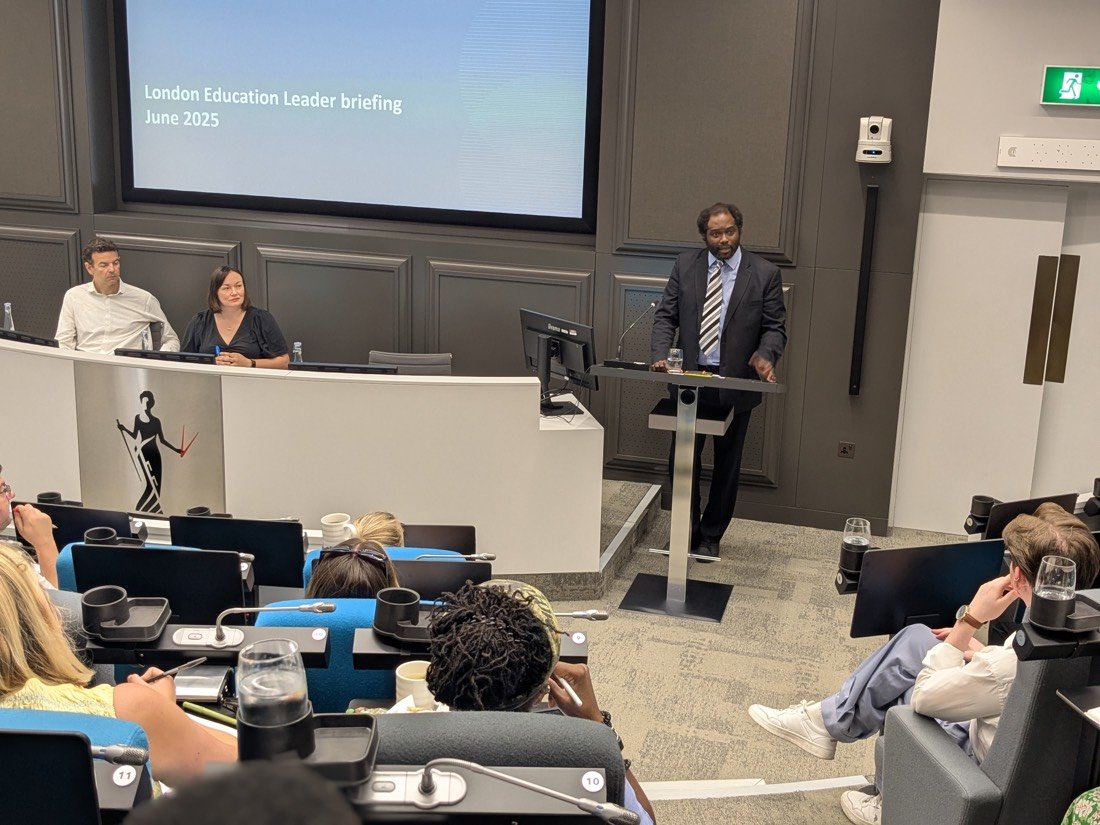
As I begin a new chapter following seven and a half years at the Greater London Authority, I have found myself reflecting on what overseeing nearly £500 million of public investment each year has taught me.
The obvious lessons relate to governance, assurance, risk, performance and accountability. Those things matter enormously and are essential to good public administration.
Yet when I look back, the lessons that stay with me most strongly feel much less technical than I expected.
In fact, many of them are surprisingly human.
Public investment is ultimately about trust
When people talk about public spending, conversations often focus on money: how much is available, how it should be allocated and whether value for money is being achieved.
Those are important questions, but they are only part of the story.
Over time, I came to realise that public investment is fundamentally an exercise in trust. The money does not belong to the organisation managing it, nor to the individuals making decisions about it. It belongs to the public.
Every funding decision therefore carries a responsibility not only to spend money correctly, but to use it in a way that creates genuine public value.
Every investment represents trust being placed in institutions, leaders and systems to create opportunities and improve lives.
The larger the budget became, the more conscious I became of that responsibility.
Relationships often matter more than systems
One of the misconceptions people sometimes have about large funding programmes is that success is primarily driven by structures, contracts and controls.
They are undoubtedly important.
However, some of the most significant achievements I have seen depended as much on relationships as they did on processes.
Throughout my time at the GLA, I worked with colleges, local authorities, independent training providers, employers, government departments, community organisations and representative bodies. What consistently struck me was how often progress depended on trust, openness and a willingness to work through challenges together.
The recent evaluation of London’s Adult Skills Fund reinforced this point. Providers repeatedly highlighted the quality of engagement between the GLA and providers and the effort made to understand the realities of delivery.
Good relationships do not eliminate problems.
They make problems easier to solve.
Data matters, but reality matters too
Anyone who has worked with me knows that I enjoy data.
I enjoy understanding how systems perform.
I enjoy turning complex information into insight.
However, some of the most important lessons I learned came not from reports but from conversations.
Over the years I visited providers, spoke with learners, met employers and participated in countless discussions about what was and was not working.
The numbers often tell part of the story. The people experiencing the system usually tell the rest.
Learner outcome surveys may tell us whether confidence has increased. Conversations with learners often reveal why.
Performance reports can highlight trends. Providers often explain the causes behind them.
The strongest decisions tend to emerge when evidence and lived experience are brought together.
Great systems learn
If there is one idea that has increasingly shaped my thinking, it is the importance of learning.
The strongest systems are not necessarily those that avoid mistakes. They are the ones that learn quickly, adapt intelligently and build on what they discover.
Much of the work we undertook involved testing approaches, evaluating impact and identifying what should be expanded, adapted or stopped.
One of the advantages of managing significant investment is that it creates opportunities to learn at scale.
The challenge is ensuring that learning survives beyond individual programmes.
Too often, pilots come and go. Teams disperse. Knowledge is lost.
The systems that achieve the most are usually those that find ways of capturing learning and embedding it into future design.
In the end, it is still about people
Perhaps the lesson that surprised me most is that as budgets grow, people become more important rather than less.
Earlier in my career, I assumed larger budgets would naturally make finance the dominant consideration. Instead, I found myself becoming increasingly interested in leadership, culture, capability and relationships.
Almost every success I am proud of can ultimately be traced back to people.
Colleagues who cared deeply about outcomes.
Providers who went the extra mile for learners.
Partners who remained committed to a shared objective.
Leaders willing to tackle difficult problems together.
As I prepared to leave my role, many of the messages I received from colleagues, partners and stakeholders did not focus on budgets, governance structures, commissioning processes or programme performance.
They focused on support, encouragement, opportunity, challenge, collaboration, belief and trust.
That was a useful reminder that while systems matter and funding matters, people tend to remember the human experience of the journey.
Final reflection
Managing nearly £500 million of public investment each year has taught me a great deal about governance, accountability, risk and performance.
But perhaps the most important lesson is that public investment is not really about money.
It is about opportunity.
Every allocation, contract, grant or programme ultimately represents somebody’s opportunity to learn, work, progress, build confidence or realise potential.
The numbers matter.
The governance matters.
The accountability matters.
But people are the reason any of it matters.
After all these years, that remains the part of the work I have enjoyed most.
As I start a new chapter, it is probably the lesson I carry forward most strongly.